 KEY Heroes
Jun 11th 2026
Buying men's coveralls online should be a simple process, yet sizing remains the primary hurdle for new buyers. These utility garments aren't built like standard apparel as they are designed for heavy layering, full-body protection against jobsite debris, and unrestricted movement through long shifts. Because of this, the measurements you use for your favorite jeans won't translate directly to a professional coverall uniform.
This guide explains how to capture your dimensions accurately, examines the functional differences between unlined and insulated builds, and helps you navigate the KEY Apparel sizing chart to ensure your order fits perfectly without the hassle of a return.
Why Coveralls Size Differently from Everyday Apparel
A utility coverall is an all-in-one enclosure meant to be worn over your street clothes, which fundamentally changes the cut of the garment. There is substantial extra room engineered into the chest and waist so the fabric can comfortably bridge your base layers, whether you're wearing a light tee or heavyweight winter thermals.
Furthermore, work coveralls are designed for the physical demands of the trades, including reaching, bending, and crouching. Sizing them like a pair of dress trousers often leads to restricted mobility or pulling across the back. Taking precise coverall measurements before you order is the most effective way to avoid these common fit issues.
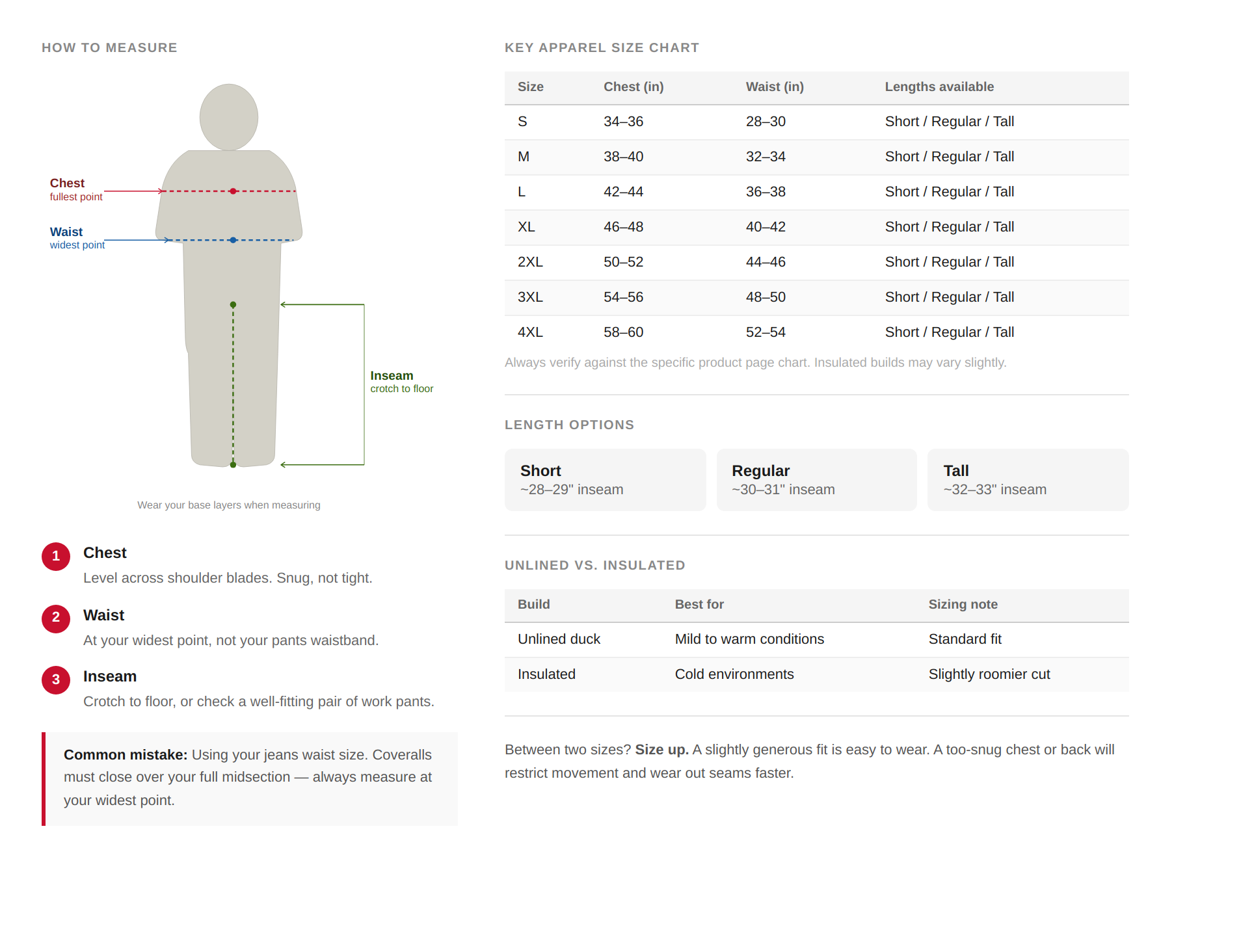
How to Take Your Coverall Measurements
You should have three specific numbers ready before shopping: your chest, waist, and inseam. For accuracy, measure while wearing the actual base layers you use on the jobsite; dimensions taken over a thin shirt will be misleading if you typically wear a bulky flannel while working.
Chest
Position a soft measuring tape around the broadest part of your chest, keeping it level across your shoulder blades. The tape should be snug but loose enough to accommodate two fingers underneath. This is generally the most straightforward measurement for most tradespeople.
Waist
This is where most sizing errors occur. You must measure at the widest point of your midsection, rather than where your jeans normally sit. Because full-body gear must close over the entire belly, using a standard pants waist measurement will likely result in a garment that is too small. Always prioritize your widest measurement point.
Inseam
Measure your inner leg from the crotch down to the floor, or check the length of a well-fitting pair of existing work pants. KEY Apparel provides specialized short, regular, and tall length options, making this number critical for maintaining mobility and safety on the job.
Unlined vs. Insulated Builds: Sizing Considerations
While the measuring process is consistent, the internal bulk of the garment changes how you should interpret the size chart.
Unlined Coveralls
Unlined duck garments are built for moderate climates and lighter layering. They offer a leaner profile for trades that require agility without extra fabric weight. If your dimensions fall between two sizes on the chart, it is generally best to size up for comfort.
Insulated Coveralls
Designed for unheated shops and outdoor winter shifts, insulated builds include a thermal lining for maximum heat retention. The cut is adjusted to accommodate this internal volume, so these garments typically feel roomier. Always reference the product-specific chart for insulated styles rather than assuming your unlined size will fit the same.
Will My Work Gear Shrink in the Wash?
Any potential shrinkage in KEY Apparel gear is minimal, as it is factored into our manufacturing process from the start. Your coveralls will maintain their fit through repeated industrial washings if you follow the care label instructions. To prolong the life of the cotton fibers, use low heat settings or hang dry when possible.
This care approach applies to both unlined duck and insulated varieties. The internal thermal lining does not require specialized handling beyond the standard cotton care guidelines.
Three Steps to Ordering the Right Size
Once your measurements are finalized, follow these steps to ensure a proper fit:
- Consult the specific size chart on the product page. Sizing for insulated builds is distinct from unlined options.
- Pick the appropriate length (short, regular, or tall). A correct inseam avoids trip hazards at the ankle and shoulder pulling.
- Choose the larger size if you land between options. Generous gear is easier to work in and places less stress on the seams.
Shop the KEY Apparel Collection Today
KEY has been outfitting tradespeople since 1908, and our sizing reflects the practical needs of those on the jobsite. Whether you require unlined protection for moderate shifts or insulated builds for extreme cold, our collection meets the demands of every frame and environment.
Explore our selection of men's coveralls, including unlined duck options and insulated coveralls. Consult the KEY sizing chart to confirm your fit, or visit our bib overalls vs. coveralls guide for further comparisons.
BOGO40 Flash Sale: Automatic buy one get one 40% off on unlined coveralls and unlined bib overalls. Offer valid through June 24, 2026.
Frequently Asked Questions About Men's Coveralls
What is the difference between unlined and insulated coveralls?
Unlined versions are ideal for moderate climates and lighter layering. Insulated options feature a thermal lining for cold-weather protection and are cut roomier to account for the extra bulk. For winter labor or unheated environments, insulated builds are the standard choice. KEY Apparel provides both styles in multiple length fits.
How do I take accurate coverall measurements?
Always measure your chest and waist at their broadest points, and check your inseam from crotch to floor. Take these dimensions while wearing your typical work layers. Measuring over thin apparel often results in selecting a size that will be too restrictive once you are fully outfitted for a shift.
Can I use my standard jeans size for coveralls?
No. Most jeans are worn below the navel, which is narrower than the midsection area that coveralls must enclose. To ensure the garment closes properly, you must use your widest torso measurement and compare it to the product-specific sizing chart before checking out.
Are coveralls appropriate as a uniform for entire crews?
Yes. KEY Apparel gear is the industry standard for outfitting crews due to its lasting durability and consistent fit options. Unlined duck is a versatile choice for many trades, while insulated builds provide essential protection for outdoor winter work. Both are engineered to survive the rigors of industrial laundering cycles.
Do these garments come in different length options?
KEY Apparel offers short, regular, and tall lengths across our entire coverall range. Finding the correct length is essential for safety; excessive fabric can cause tripping, while insufficient length restricts overhead reaching and motion. For most average-height workers, the regular fit provides a comfortable and reliable baseline.